


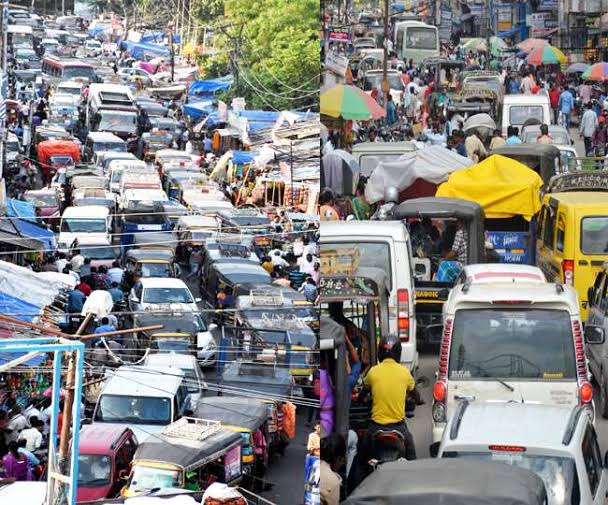
Patna, The capital of Bihar is no longer a city; it is a parking lot with delusions of grandeur. At any hour of the day, the average speed on its main arteries hovers between 6 and 8 km/h – slower than a brisk walk and barely faster than a drunk cow. Fraser Road, Exhibition Road, Boring Road (the name was always prophetic) have been surrendered to a chaotic swarm of battery rickshaws, petrol autos, CNG tuk-tuks, and the ubiquitous “totos” that multiply like viruses because no one in the Bihar government has the spine to regulate them.
These slow-moving, smoke-belching, horn-blaring contraptions are not marginal players; they are the dominant species on Bihar’s roads. In Patna alone, more than 60,000 e-rickshaws and an uncounted army of illegal petrol and CNG autos clog every intersection. They park wherever gravity stops them – on footpaths, in the middle of roundabouts, across zebra crossings that exist only in the imagination of long-dead town planners. There are no parking zones because there are no parking facilities. There are no charging stations because no one in the Transport Department ever thought electric vehicles would number in the tens of thousands when they were busy collecting bribes for fitness certificates.
The result is catastrophic. Air pollution in Patna now routinely breaches WHO limits by factors of ten. Noise levels are those of a war zone with malfunctioning sirens. A ten-minute journey now takes an hour, torching productivity, fuel, and tempers in equal measure. Businesses are fleeing to Ranchi and Raipur because no client wants to spend half a day trapped in a car that moves slower than continental drift.
And the Bihar government’s response? A deafening silence punctuated by the occasional ribbon-cutting for yet another flyover that will be instantly swallowed by the same unregulated horde it was meant to tame.
Enough.
It is time to treat Bihar’s urban transport crisis as the governance failure it manifestly is.
First, impose an immediate moratorium on registration of all new slow-moving vehicles – battery rickshaws, e-loaders, petrol autos – in every municipal corporation and nagar parishad area until proper parking and charging infrastructure exists. No exceptions, no “temporary” permits, no ministerial phone calls. If you cannot park it and charge it legally, you cannot register it. Full stop.
Second, create exclusive, fenced, paid parking and charging hubs on the city periphery and enforce tow-away zones in core urban areas. Any vehicle found parked on a public road without authorization should be impounded on first offence and crushed on the third. The message must be brutal because the indulgence has already been lethal.
Third, launch a publicly owned, air-conditioned, GPS-tracked fleet of high-capacity electric buses – 1,000 in Patna, 300 in Gaya, Bhagalpur and Muzaffarpur each – within the next 24 months. Fund it by slapping a ₹500 annual congestion cess on every private car and ₹2,000 on every e-rickshaw registered in urban limits. The polluter must pay.
Fourth, ban all internal-combustion and battery rickshaws from arterial roads between 7 am and 10 pm. They can ply in interior colonies where they belong, not choke the city’s lifelines.
These measures will be called anti-poor by the usual rent-seeking lobbies who have turned public roads into private fiefdoms. Let them wail. The truly poor are the millions who inhale poison every day, who lose wages sitting in traffic, whose children develop asthma because a failed state let a few thousand operators hold an entire population to ransom.
Bihar’s cities are on the verge of becoming unliveable. The government still has time to choose between decisive action and permanent infamy. History will not judge it kindly if it continues to mistake cowardice for compassion.
The horns are blaring. The clock is ticking. Act, or get out of the way.