



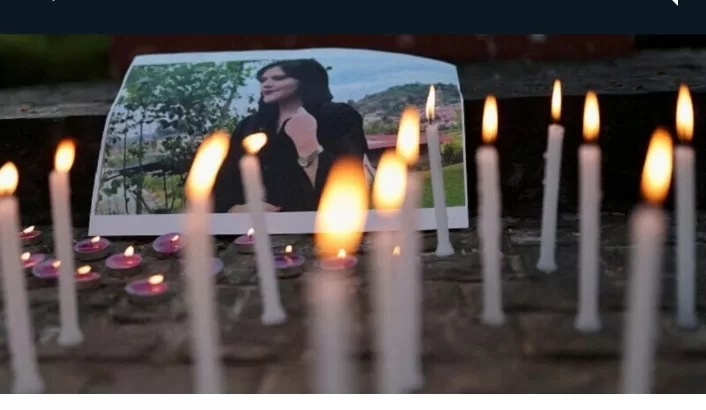
Tehran, Iran – Iranian authorities have impeded the family of Mahsa Amini from conducting a ceremony to mark the first anniversary of her tragic death, restraining her father to his residence. Simultaneously, sporadic protests have been reported across the nation, despite a heavy security presence, according to human rights organizations.
Mahsa Amini, a 22-year-old Iranian Kurd, passed away several days after her arrest by religious police on allegations of violating the stringent dress code for women enforced since the 1979 Islamic Revolution. Although her family asserts that she died from a head injury, Iranian authorities dispute this claim.
The grief over Mahsa Amini’s demise evolved into a series of unprecedented protests that endured for weeks. During these protests, women boldly removed their mandatory headscarves, openly challenging the Islamic republic’s governance system under Supreme Leader Ayatollah Ali Khamenei.
On the occasion of the anniversary, Mahsa Amini’s father, Amjad, was detained early on Saturday as he left his residence in the western town of Saqez. Subsequently, he was released after receiving a warning not to hold a memorial service at his daughter’s gravesite. This information was disclosed by the Kurdistan Human Rights Network (KHRN), 1500tasvir monitor, and the Norway-based Iran Human Rights (IHR).
Security personnel were stationed outside the Amini family home to prevent Amjad from leaving, as corroborated in separate statements by these groups.
“IHR” stated, “Amjad Amini is under house arrest… Security forces are preventing him from visiting his daughter’s grave.”
Last week, intelligence officials had already summoned Amjad Amini after he announced his intention to organize a memorial ceremony. Additionally, one of Amini’s uncles, Safa Aeli, was detained in Saqez on September 5 and remains in custody.
As of the time of reporting, there was no indication of the commemorative ceremony taking place at Mahsa Amini’s grave in the Aichi cemetery in Saqez. The rights groups indicated that security forces had blocked access to the site.
The Kurdish-focused group Hengaw reported that a young man named Fardin Jafari was in critical condition in a hospital after sustaining a gunshot wound to the head near the cemetery. However, independent verification of this report was not immediately available.
The protests sparked by Mahsa Amini’s death gradually lost momentum due to a crackdown that witnessed security forces killing 551 protesters, according to IHR, and arresting more than 22,000 individuals, as reported by Amnesty International.
Iranian authorities contend that the protests constituted “riots” incited by foreign governments and hostile media and that dozens of security personnel were also killed in the process.
To prevent relatives of those killed during the protests from speaking out, campaigners allege that authorities have intensified their crackdown ahead of the anniversary, subjecting family members to interrogations, arrests, prosecutions, and imprisonment. This has led to what Human Rights Watch describes as a “chokehold on dissent.”
In response to these developments, people in western Iran have reportedly expressed their discontent through a general strike, with shops shuttered in a dozen towns and cities, including Saqez, according to Hengaw.
In the capital, Tehran, and its satellite city of Karaj, witnesses have reported a heavy security presence, with anti-riot police and security vehicles patrolling main thoroughfares and squares.
Moreover, Persian-language channels operating outside Iran, such as Iran International, have broadcast footage of residents shouting “Death to the dictator” and the main protest slogan of “Woman, Life, Freedom” from apartment buildings in Tehran and Karaj during the night.
Monitory 1500tasvir shared footage of a daytime protest on Saturday in the Gohardasht district of Karaj, where dozens of people chanted slogans such as “we will take Iran back!”
Similar gatherings have been documented in the central city of Isfahan and the southern city of Shiraz.
In a symbolic gesture on Friday, President Ebrahim Raisi met with families of security personnel who lost their lives during the protests while on a visit to the northeastern city of Mashhad, as reported by state media.
Activists have reported a fresh wave of arrests in western Iran, which has a predominantly Kurdish population, in the lead-up to the anniversary. The state news agency disclosed that several groups have been arrested on suspicion of “planning to create chaos” and producing content for “hostile media.”
In a show of solidarity, Iranian expatriates have been holding commemorative rallies worldwide, from Sydney to Toronto. Thousands gathered at Place de la Bastille in central Paris, chanting protest slogans and waving pre-revolutionary flags, under the banner “Say her name!”
By AFP