


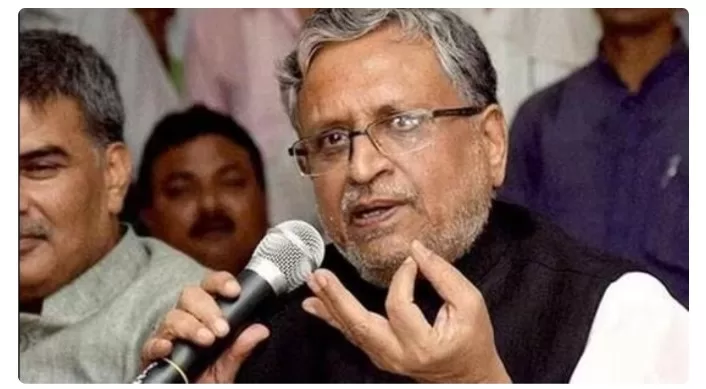
Bharatiya Janata Party (BJP) luminary and distinguished Rajya Sabha MP, Sushil Kumar Modi, expounded upon the BJP’s evolving political landscape in an exclusive discourse with Hindustan Times. He eloquently articulated that the BJP, once tethered to the perception of catering to the upper echelons of society, has now metamorphosed into a political entity with a diversified support base, seamlessly embracing both the ‘Mandal’ and ‘Kamandal’ ideologies.
Intricately dissecting the political tapestry, Modi elucidated that ‘Mandal’ encapsulates the erstwhile realm of Mandal politics, an epoch where social and educationally marginalized sections were identified and accorded reservations, as per the Mandal Commission’s recommendations. Concurrently, ‘Kamandal’ signifies the BJP’s alignment with the tenets of Hindutva and the cherished Ram Janambhoomi cause, and the overarching fabric of nationalistic fervor that it entails.
Modi eloquently elucidated that the BJP’s historical image as a bastion for upper-caste elites has undergone a profound metamorphosis. The party’s reach now transcends traditional boundaries, encompassing not only the Other Backward Classes (OBCs) but also the Economically Backward Classes (EBCs), Dalits, and various other strata of society. In a profound statement, he asserted that the BJP’s core constituency has burgeoned to encompass an amalgamation of diverse backgrounds.
Furthermore, Modi underscored the BJP’s commitment to reevaluating the extant reservation framework, despite the Supreme Court’s precedent-setting Sawhney & Others vs Union of India ruling, which limits reservations to 50%. He opined that in several states, this threshold has already been surpassed, implying that the ceiling is not insurmountable. Emphatically, Modi asserted the BJP’s support for state-led caste censuses, highlighting their endeavors in Bihar and Karnataka.
However, he was quick to point out that political rivals, including the Rashtriya Janata Dal (RJD) and Janata Dal-United (JD-U), sought to stigmatize the BJP as anti-backward classes, manifesting through public interest litigations (PILs) against Bihar’s caste survey. This triggered legal debates about the authority vested in states for conducting such surveys.
Modi also cast aspersions on the Congress party’s commitment to similar surveys, particularly in states where they hold power, questioning the omission of surveys in Rajasthan, Himachal Pradesh, and Chhattisgarh. When queried about a national caste census, Modi deemed it impractical due to India’s vast size and demographic heterogeneity.
Lastly, Modi addressed the issue of reservations’ longevity, refuting claims that RSS leader Mohan Bhagwat had advocated for a reservation “shelf life.” He assured that the Sangh Parivar remains supportive of reservations until societal discrimination persists.
The recent release of Bihar’s caste survey findings was a focal point of discussion, revealing that Backward Classes (BC) constitute 27.12% of the population, Extremely Backward Classes (EBC) 36.01%, Scheduled Castes (SC) 19.65%, Scheduled Tribes (ST) 1.68%, and the general category 15.52%. A staggering revelation emerged with 63% of the state’s populace falling within the ambit of OBCs and EBCs. Additionally, the survey disclosed that 81.99% of Bihar’s population adheres to the Hindu faith, with 17.7% professing Islam.
In this nuanced discourse, Sushil Kumar Modi elucidated the BJP’s transformative journey and its resolute commitment to social justice and political inclusivity.