



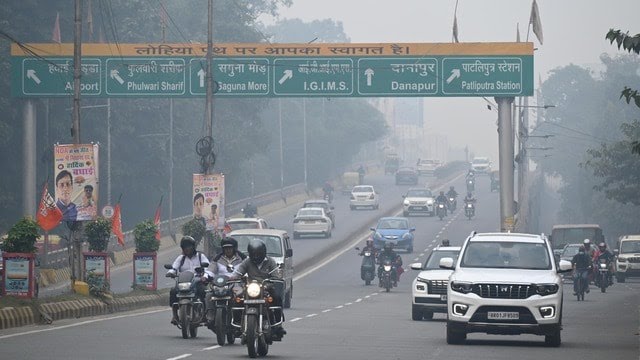
Patna, Air pollution levels across Bihar have risen sharply in recent days, coinciding with the onset of colder weather that typically traps pollutants closer to the ground. On Thursday, Sasaram recorded the state’s worst air quality, with an Air Quality Index (AQI) of 214, placing it firmly in the “poor” category. Patna, the state capital, also registered polluted air, with several monitoring stations reporting “poor” to “very poor” readings.
According to data compiled by the Bihar State Pollution Control Board and the Central Pollution Control Board’s continuous ambient air quality monitoring network, particulate matter (both PM10 and PM2.5) remained the dominant pollutant. In Patna, the Samanpura station recorded an AQI of 218 and the Gandhi Maidan station 239 on Thursday, both in the “poor” range. Danapur reported a moderate 141, while Patna City showed a comparatively better reading of 81.
As of 7 a.m. on Friday, 5 December, AQI levels across monitored cities in Bihar stood as follows:
– Gaya: 189 (Poor)
– Sasaram: 178 (Poor)
– Araria: 172 (Poor)
– Patna: 172 (Poor)
– Begusarai: 142 (Moderate)
– Hajipur: 139 (Moderate)
– Arrah: 137 (Moderate)
– Buxar: 129 (Moderate)
– Kishanganj: 128 (Moderate)
– Bihar Sharif: 125 (Moderate)
– Munger: 124 (Moderate)
– Muzaffarpur: 124 (Moderate)
– Rajgir: 105 (Moderate)
– Bettiah: 103 (Moderate)
– Aurangabad: 102 (Moderate)
The spike in pollution comes amid ongoing metro construction and other infrastructure work near Gandhi Maidan, one of Patna’s most prominent public spaces. Dust from these projects, combined with vehicular emissions and low wind speeds typical of the winter season, has exacerbated the situation. The annual Patna Book Fair, which opens today at Gandhi Maidan, is likely to draw large crowds, potentially adding to local dust and traffic-related emissions. Last year, elevated dust levels had marred the fair; organisers and civic authorities face renewed pressure to mitigate the impact.
Environmentalists and public-health experts have long warned that Bihar’s air quality deteriorates predictably every winter as temperature inversion layers trap pollutants. With mercury expected to drop further in the coming days — the India Meteorological Department has forecast minimum temperatures falling to around 3°C in parts of the state — the risk of sustained high pollution remains elevated unless stringent dust-control and emission-reduction measures are enforced promptly.
For residents, particularly those with respiratory conditions, medical authorities continue to advise limiting outdoor activity during early morning and late evening hours when pollutant concentrations peak.