

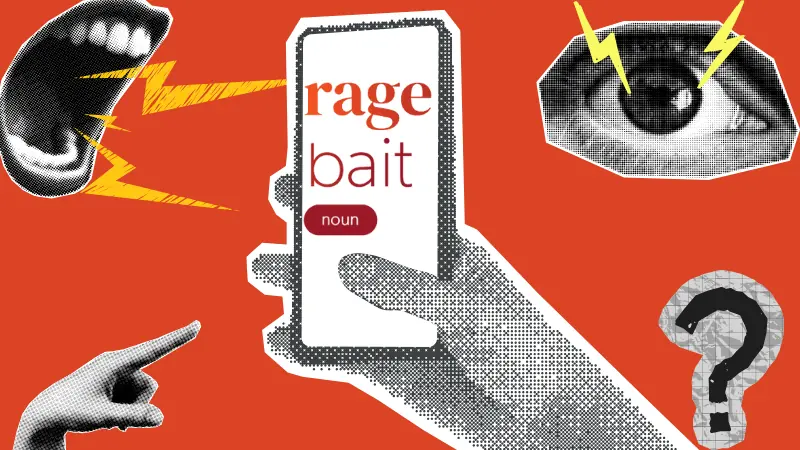
The internet has spoken, loudly, angrily, and probably in all caps. After more than 30,000 people voted, Oxford University Press has crowned rage bait its 2025 Word of the Year. Among the shortlisted terms were aura farming and biohack.
With a news cycle bursting at the seams with culture wars, conspiracy theories, and that one influencer’s ridiculous take, Oxford says the term perfectly captures how internet content is increasingly engineered to make us furious. It has also tripled in usage in just 12 months.
And yes, before the pedants rush in: rage bait is two words. Oxford knows. They clarified that the Word of the Year can be a single concept, even if it’s technically a phrase. In this case, “rage” and “bait” fuse into one unit of meaning, a linguistic monster born of the internet age. It’s similar to clickbait, but far angrier, far messier, and far more likely to ruin your group chat.
So… what is rage bait, beyond your uncle’s Facebook feed?
Oxford defines it as online content “deliberately designed to elicit anger or outrage” — often just to drive clicks and engagement. It’s clickbait’s evil twin — not here to annoy you into clicking, but to ruin your day and “encourage you to quote-tweet it with rage”.
Rage bait isn’t new. It first popped up on the internet in 2002. But in 2025? It’s a whole business model, from performative politics to creator meltdown bait to “who allowed this to go viral?” trends.
Last year, it was brain rot. This year, it’s rage bait. OUP says last year’s winner reflected the mental mush of endless scrolling. This year’s pick highlights the content actively trying to wind us up. Together, they complete the toxic cycle: scroll → rage → repeat → collapse.
Casper Grathwohl, president of Oxford Languages, says the rise of rage bait reveals how the internet has evolved; it’s no longer just about grabbing attention — it’s about hijacking our emotions. We’re not doom-scrolling anymore, we’re doom-engaging.
OUP says that rage bait has become mainstream enough that newsrooms and politicians now use it intentionally, or fall victim to it, in the name of “engagement”. Not us, though. We only spread happiness. And memes.
Rage bait may be a funny term, but the reason it exists? Not so funny. It’s a warning label for the internet we’ve created, one where fury equals currency.
So next time you feel an urge to slam-quote something that made you irrationally angry, maybe don’t? Because somewhere, an algorithm is smiling. And honestly, haven’t we all suffered enough?