


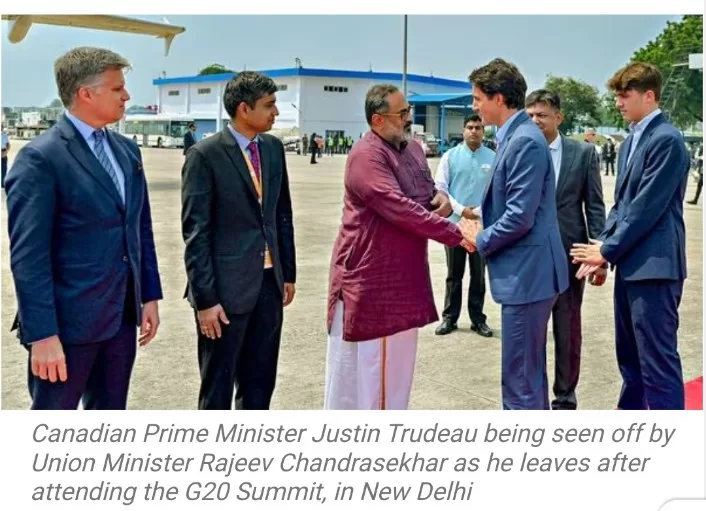
In a diplomatic exchange of gestures, India extended a gracious offer of the esteemed ‘Air India One’ aircraft to facilitate the return of Canadian Prime Minister Justin Trudeau and his delegation, following a frustrating delay of nearly 48 hours due to technical difficulties aboard Canada’s official aircraft during the G20 Summit. However, opting to await their backup aircraft, the Canadian side eventually embarked on their journey back to Ottawa, with Indian Union Minister Rajeev Chandrashekhar accompanying them to the airport during their departure.
This intricate turn of events unfolded within the context of a somewhat turbulent visit by the Canadian delegation to India, marked by simmering tensions in the bilateral relationship. These frictions have arisen primarily due to Canada’s perceived reluctance in addressing concerns related to anti-India activities occurring on its soil, including secessionist movements and violence against Indian diplomats and institutions.
During a bilateral meeting with Prime Minister Justin Trudeau, Indian Prime Minister Narendra Modi conveyed India’s deep-seated concerns regarding these anti-India activities, highlighting their promotion of secessionism, incitement of violence against Indian diplomatic personnel, damage to diplomatic facilities, and threats to the Indian community in Canada and their places of worship. Furthermore, the Ministry of External Affairs emphasized the interconnectedness of these forces with organized crime, drug syndicates, and human trafficking, underscoring the urgency of both nations collaborating to counter such multifaceted threats.
However, it appears that Prime Minister Trudeau may not have fully grasped the gravity of Prime Minister Modi’s concerns, as he responded by invoking the concept of “foreign interference” and, in a balancing act, stressed the importance of adhering to the rule of law.
The ramifications of this diplomatic imbroglio have reverberated even within Canada’s borders, where reports from reputable news outlets such as Reuters and Bloomberg have portrayed Trudeau as being on the receiving end of a “scolding” and “criticism” from Prime Minister Modi during their discussions. This development has prompted opposition leader Pierre Poilievre to voice his disapproval, decrying the repeated perceived humiliations suffered by the Canadian Prime Minister on the international stage.
As the dust settles on this contentious visit, it remains to be seen how these diplomatic tensions will evolve and whether the two nations can find common ground amid their differences.